
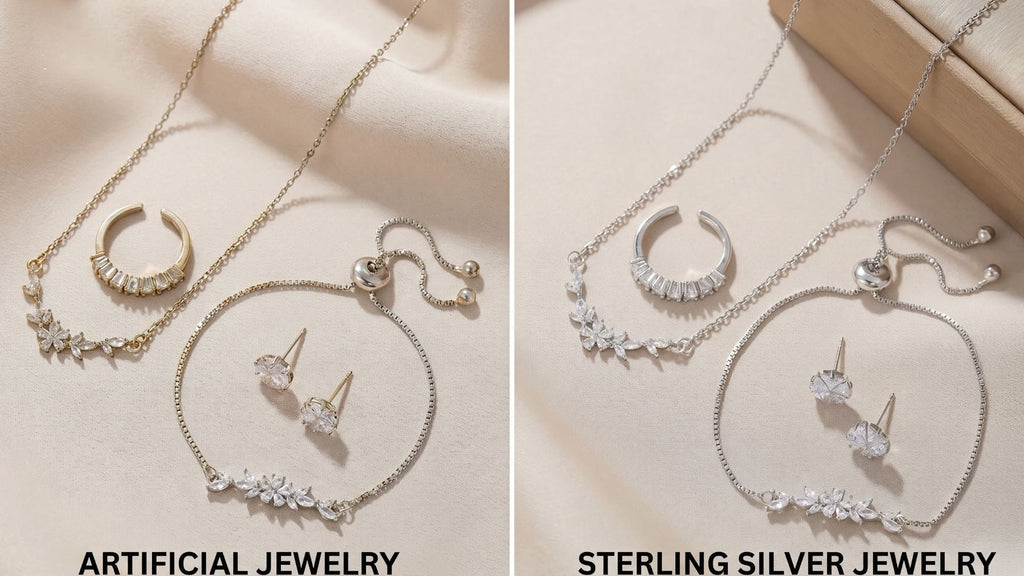
925 Silver vs Artificial Jewelry: Which Is Better?
925 Silver vs Artificial Jewelry: Which Is Better?
We've all done it.

You're scrolling through Instagram, spot a gorgeous necklace, click the link, and suddenly you're looking at two options.
One costs ₹399.
The other costs ₹2,499.
They look almost identical.
Same design. Same sparkle. Same aesthetic.
So naturally, the question pops up:
Why would anyone spend more?
It's a fair question.
After all, if both pieces look beautiful in photos, what's the difference?
The answer is that while artificial jewelry and 925 silver jewelry may sometimes look similar on day one, they are designed for completely different purposes.
One is made for the moment.
The other is made for the years that follow.
If you're trying to decide between sterling silver and artificial jewelry, here's what actually matters.
First, Let's Clear Something Up
Artificial jewelry isn't "bad."
In fact, it serves a purpose.
Fashion jewelry allows people to experiment with trends without spending too much money. It's great for one-time occasions, themed outfits, destination weddings, or styles you aren't sure you'll love six months from now.
The problem starts when people expect artificial jewelry to perform like fine jewelry.
That's where disappointment usually enters the story.
Because while the two may look similar initially, their longevity is often worlds apart.
What Is Artificial Jewelry?
Artificial jewelry is typically made from base metals like brass, zinc alloy, copper, nickel, or stainless steel.
To achieve a silver-like appearance, these metals are often coated with a silver-colored finish or plating.
This allows brands to create attractive designs at a lower price point.
And there's nothing wrong with that.
As long as you're buying it for what it is.
Fashion jewelry is designed to provide style.
It isn't necessarily designed to last for years.
What Is 925 Silver Jewelry?
925 silver, also known as sterling silver, is a precious metal.
The number 925 means the jewelry contains 92.5% pure silver and 7.5% strengthening metals.
This combination creates jewelry that's durable enough for everyday wear while maintaining the beauty and value of genuine silver.
Unlike artificial jewelry, sterling silver isn't simply coated to look silver.
It is silver.
And that distinction changes everything.
The Real Difference Shows Up After a Few Months
When you first open the box, artificial jewelry can look fantastic.
Sometimes the difference isn't obvious at all.
The real test begins after regular wear.
Think about the jewelry you actually use.
The necklace you wear to work.
The bracelet you never take off.
The ring that has become part of your everyday routine.
These are the pieces that reveal the difference between materials.
Artificial jewelry often starts losing its finish over time.
Plating wears away.
Edges fade.
The original metal underneath begins to appear.
Once that happens, there's usually no easy way to restore it.
Sterling silver behaves differently.
It may develop tarnish occasionally, but tarnish isn't damage.
It's a natural surface reaction that can be cleaned and polished.
Years later, a silver piece can still look beautiful.
That's why many people describe sterling silver as jewelry that ages gracefully.
Which One Is Better for Everyday Wear?
This is where 925 silver usually wins.
Most people don't want to think about their jewelry every morning.
They want pieces that simply work.
Jewelry that goes with everything.
Jewelry they can reach for without hesitation.
Sterling silver excels in this role.
Its neutral tone pairs effortlessly with casual outfits, office wear, festive clothing, and evening looks.
It doesn't demand attention.
It complements.
Artificial jewelry can certainly be worn daily, but repeated exposure to sweat, moisture, perfumes, and regular use often affects its appearance more quickly.
If you're building an everyday jewelry collection, sterling silver tends to be the more reliable choice.
Let's Talk About Skin Sensitivity
If you've ever removed a ring and discovered a green mark underneath, you're not alone.
Many artificial jewelry pieces contain metals that can react with skin, especially when exposed to moisture.
Some people experience irritation.
Others notice discoloration.
For many wearers, sterling silver is a more comfortable option.
Because it contains a high percentage of genuine silver, it's generally better tolerated than many low-cost alloys.
Of course, every person's skin is different.
But when comfort matters, material quality becomes important.
The Cost Question Everyone Asks
At first glance, artificial jewelry appears to be the winner.
It's cheaper.
Sometimes significantly cheaper.
But let's look at it differently.
Imagine buying a ₹500 necklace every few months because the previous one lost its finish.
Then imagine buying a sterling silver necklace that stays with you for years.
Which one actually costs less over time?
The answer isn't always obvious from the price tag alone.
Experienced jewelry buyers often think in terms of value rather than cost.
A piece you wear hundreds of times can become surprisingly affordable when viewed that way.
Trends vs Timelessness
Artificial jewelry shines when it comes to trends.
Chunky statement pieces.
Experimental designs.
Seasonal styles.
Fashion-forward looks.
It's a fun way to play with changing aesthetics.
Sterling silver serves a different purpose.
It focuses on longevity.
The goal isn't to look relevant for one season.
The goal is to remain beautiful year after year.
A simple silver chain.
A pair of classic studs.
A delicate bracelet.
These are the pieces that rarely feel outdated.
They become staples.
And staples are often the hardest-working pieces in any jewelry collection.
The Emotional Value Nobody Talks About
Here's something that's difficult to measure.
Artificial jewelry is usually purchased.
Fine jewelry is often kept.
Think about the jewelry pieces that carry memories.
The bracelet gifted on a birthday.
The necklace purchased with a first salary.
The ring worn during a meaningful chapter of life.
These pieces become part of personal stories.
And when jewelry is meant to hold memories, durability matters.
Because memories deserve something that lasts.
So, Which One Is Better?
The honest answer is that it depends on what you're looking for.
If you want a trendy piece for a specific occasion, artificial jewelry can be a great choice.
If you want jewelry that stays with you through daily life, special moments, changing trends, and years of wear, 925 sterling silver offers advantages that artificial jewelry simply can't replicate.
It's not about one being right and the other being wrong.
It's about understanding the purpose of each.
Artificial jewelry is often about the moment.
Sterling silver is often about the journey.
And if you're building a jewelry collection you'll still love years from now, that's where 925 silver truly shines.
At Himtaj, we craft every piece in authentic 925 sterling silver because we believe jewelry should be more than a passing trend. It should be something you wear, cherish, and carry forward through the moments that matter most.
